Tutorial 10 of 10
Planning with the weather forecast
Intermediate 8 min
Use nine days of MET Norway forecast to see frost risk and soil warmth, decide when to sow and plant, water each bed, and move tasks away from bad weather.
The Forecast view checks your garden plan against the weather of the next nine days. It needs the place of your garden: set it on the plan (search or coordinates) once, then press Load the forecast. The forecast comes from MET Norway, the Norwegian Meteorological Institute, and covers the whole world.
The days ahead
The forecast table shows for each day the lowest and highest temperature, rain, the strongest wind, the frost risk and two values Greenplot works out for you:
- Frost risk — frost at a night minimum of 0 °C or lower; ground frost likely at 3 °C or lower on a clear or calm night (cold air settles on the ground); a cold night at 5 °C or lower, which tender plants like tomatoes, beans and courgettes dislike.
- Soil 10 cm — an estimate of the soil temperature where seeds lie, from the air temperature: soil follows the daily mean temperature with a lag of a few days and warms a little more on sunny days.
- Water use (ET₀) — how much water a short green lawn would lose that day, from the day's temperature range and your latitude (the Hargreaves method).
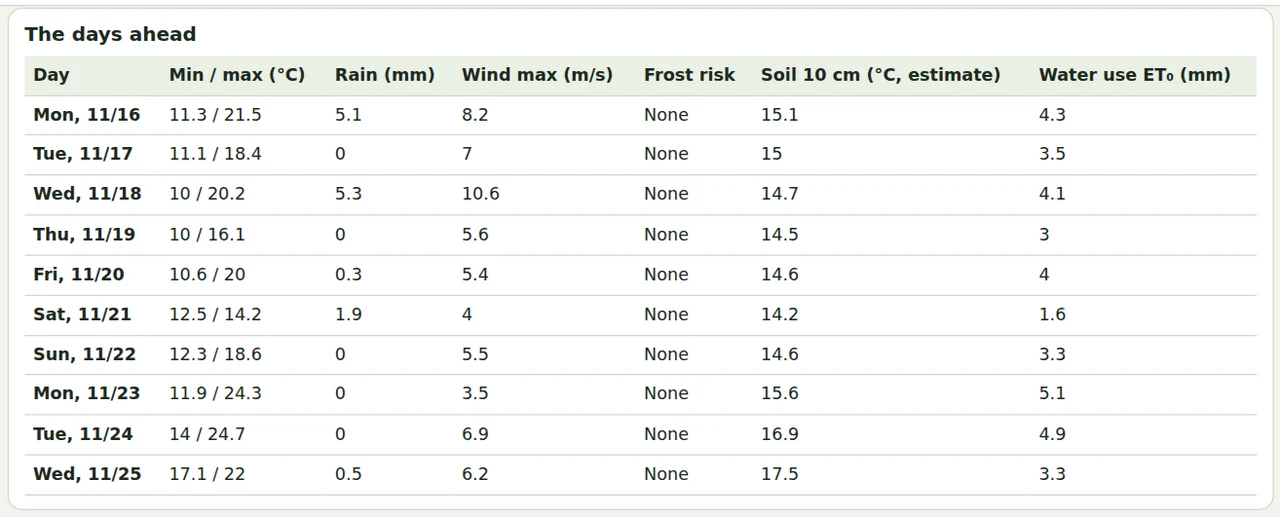
The soil temperature is a model, not a measurement. Mulch, shade and wet clay keep soil cooler; raised beds and dark fleece warm it. When it matters, a soil thermometer at 10 cm is the better guide.
Sowing and planting
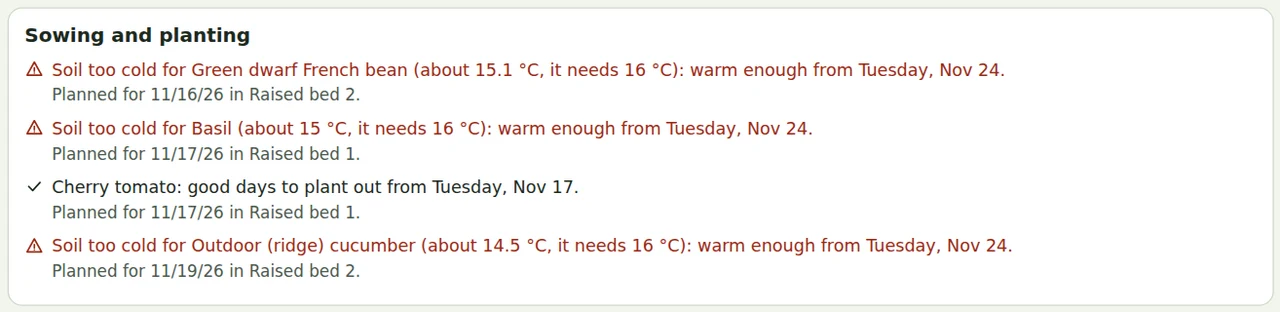
Every planting whose sowing or planting-out date falls in the forecast window (or lies up to two weeks back and is not done yet) is checked day by day:
- no frost in the next four to five days — and for tender plants no ground frost or cold nights either,
- soil warm enough for the seed (beans and cucumbers need about 16 °C, carrots and peas 4 °C),
- no downpour of 10 mm or more on the day.
You then read, for example, “Frost on Thursday: wait with tomatoes until Saturday.” or “Soil too cold for bush beans (about 15 °C, it needs 16 °C): warm enough from Tuesday.” When no day in the forecast fits, Greenplot says so — check again in a few days.
Watering plan
For each bed Greenplot keeps a simple water account: the plants use water by their growth stage (young plants little, full-grown ones more), rain fills the account, and when the bed is short of a soaking — 8 mm for thirsty plants, 12 mm for most, 18 mm for drought-tolerant ones — a watering day is planned with the litres for the bed's area. If rain the next day covers it, the watering is left out. Beds linked to a greenhouse on the plan get no rain.
Water on the days shown with a good soaking rather than a little every day; the roots go deeper.
Tasks to move
Your own tasks in the forecast window get a hint when the weather spoils them: skip a watering after rain, move weeding or harvesting away from a downpour or a gale, don't feed the day before heavy rain (it washes away), prune plums and cherries only on dry days (silver leaf). One-off tasks can be moved with one click; repeating ones you adjust yourself.
The next two hours
In Norway, Sweden, Finland and Denmark MET Norway also offers a radar nowcast: rain in five-minute steps for the next two hours. Greenplot shows when rain starts and stops and how heavy it gets. Elsewhere MET Norway has no nowcast, and the day forecast is all there is.
The same planning is available to other tools and assistants as the Garden Forecast Planner tool.
Ready to try it?